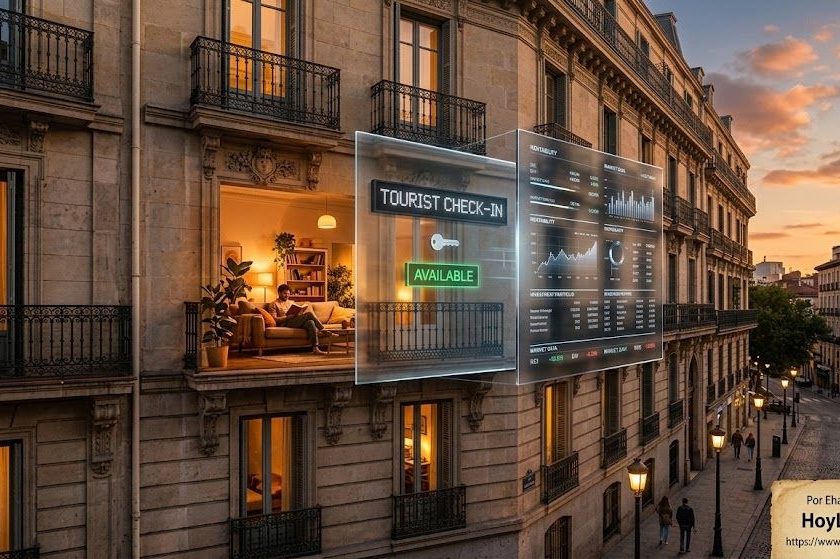

The leader of tomorrow does not live within walls; inhabits the perfect intersection of human hospitality and data intelligence.
Technological transformation, international expansion, new investment models, and artificial intelligence are redefining the profile of those who will lead the hospitality industry over the next decade. The challenge is no longer merely finding managers, but understanding which capabilities will remain decisive in a constantly changing sector. More than a technological transformation, the industry faces a redefinition of the very concept of leadership.
By Ehab Soltan
HoyLunes – An Everyday Scene That Is No Longer the Same, it is seven o’clock in the evening. Apparently, it is just another evening in any hotel. In the lobby of a five-star boutique establishment, the flow of guests is constant. However, the real action is not happening in plain sight. The director is not reviewing a complaint log in an isolated office, but is instead facing a unified interface on their tablet.
In a matter of three minutes, the executive must resolve multiple simultaneous fronts. On one hand, they manage an alert in the management system regarding an operational incident on the main floor and a negative review that threatens the business’s digital reputation. On the other, they address a crash in the cybersecurity node of the premium Wi-Fi network, review the digital signature of the month’s carbon footprint audit, and, finally, connect to a videoconference with a London-based investment fund to justify the revenue per available room (RevPAR) of the last quarter.
The question arises immediately in the face of this reality: What does it truly mean to lead a hotel in 2026? Answering that question requires looking far beyond the front desk. The answer is resounding: managing an establishment is no longer just about managing rooms and smiling in the lobby. The traditional director is an endangered species.
Managing a hotel is no longer about managing rooms; the current challenge is leading a hyper-connected ecosystem where the slightest digital failure collapses the guest’s physical experience.
The Change Is Not in Selection. It Is in Leadership.
For decades, the equation for success in hospitality was linear and predictable. A good leader was someone who mastered operations to the millimeter, possessed a sharp nose for sales, and demonstrated an innate vocation for service and the guest experience. If the dish came out on time and the room was spotless, the business worked.
Today, that knowledge is barely the absolute baseline. It is no longer enough to master daily operations. An unprecedented complexity of variables has converged on the playing field: artificial intelligence algorithms setting dynamic prices in real-time, massive management of behavioral data, robotic automation processes in housekeeping services, aggressive internationalization strategies, geopolitical risks shifting tourist flows overnight, stringent sustainability regulations, and new financial models where the property owner is rarely the brand operator. The landscape has not changed gradually; it has been completely refounded.
The Hotel Ceases to Be a Building and Becomes an Ecosystem
The hotel has stopped being understood merely as a building. Today’s leader no longer administers the four walls of an establishment; they manage a hyper-connected, multidimensional ecosystem where three major environments converge:
- The digital environment: E-commerce platforms, online reputation, and cybersecurity.
- The operational environment: Management of multicultural teams, automation, robotics, and sustainability.
- The financial environment: Investor pressure and management models based on the separation of property and brand.
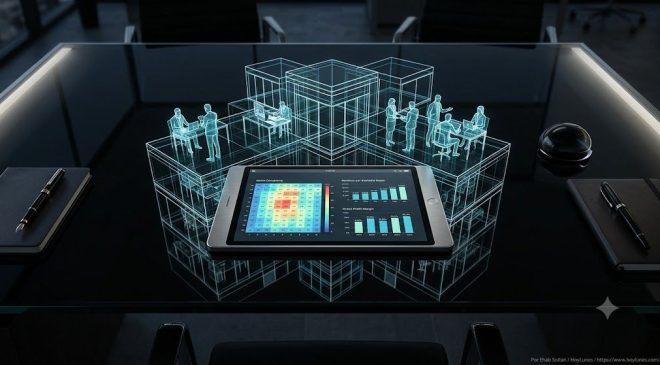
Each of these dimensions directly influences the others. The director sits at the center of this matrix. They must ensure security to protect the banking data of thousands of users, while optimizing distribution across online channels and maintaining the cohesion of a human team made up of people from dozens of different nationalities. The pressure is no longer local; it is the tension inherent to a complex system where the slightest failure in a digital node collapses the guest’s physical experience.
In the end, every decision made by this new leadership finishes by influencing something the guest perceives with absolute clarity: service quality, response speed during an incident, data security, or the coherence of the experience they live throughout their stay.
Artificial Intelligence Changes the Tools, Not Necessarily the Leadership
With the definitive emergence of generative and predictive artificial intelligence in tourism, the wrong question echoing through corporate corridors is whether technology will replace executives. The correct question, with a much greater strategic runway, is: Which decisions will continue to require exclusively human judgment?
Technology can write automated responses to reviews, predict food inventory to reduce waste, or design personalized itineraries through algorithms. However, the machine lacks the capacity to build trust at a collective bargaining table, to inspire loyalty in a team amidst a reputational crisis, to shape the organizational culture that defines a brand’s identity, or to apply intuition and empathy to a dissatisfied customer. Artificial intelligence changes the tools of the trade; the more powerful the technology, the greater the human responsibility over critical decisions. Judgment and humanity remain the property of the leader.

The Competencies Beginning to Define the New Leader
The labor market no longer demands a list of traditional technical skills. Leadership is no longer measured solely by what a person knows how to do and begins to be valued for their ability to integrate vastly different disciplines. The most valuable competencies for the next ten years are precisely those that most strongly resist being automated:
- Strategic vision and interdisciplinary thinking: The ability to connect technology with finance and consumer sociology.
- Continuous learning: The humility to understand that the tools learned last year may be obsolete today.
- Emotional intelligence and multicultural leadership: The faculty to guide diverse teams, eliminating cultural barriers and fostering environments of psychological safety.
- Uncertainty management: Making sound decisions with incomplete or rapidly changing information.
- Ethical criteria: Evaluating the environmental and social impact of every commercial decision, understanding sustainability not as a marketing campaign, but as the survival of the business.
The more powerful and omnipresent technology becomes, the greater the human responsibility over critical decisions.
The Demographic Evolution of Command
This redefinition of capabilities is accelerating a profound shift in the demographic profile of senior management. The leadership of the future breaks definitively with the industry’s historical male bias. Driven by a university talent pool that is predominantly female and by the demands of investment funds operating under diversity and corporate governance (**ESG**) criteria, the incorporation of women into decision-making committees is no longer an optimistic prediction: it is a structural transformation defining the competitiveness of the most advanced hospitality companies.
Competition Also Changes Direction
For generations, selection dynamics were unidirectional: dozens of candidates competed fiercely to win the approval of a major hotel chain. Today, the situation has reversed. Competition has changed direction, and it is now companies competing for organizational talent. The question is no longer merely who finds good leaders, but who manages to convince them to stay.
Top hospitality professionals no longer look solely for a competitive salary. They seek corporate cultures that breathe innovation, demonstrate an authentic commitment to social purpose, and offer management flexibility and autonomy. Those groups trapped in rigid, bureaucratic hierarchical structures are suffering a silent brain drain toward corporations that view the professional as a partner, not a resource.
Are We Training the Executives We Will Need Ten Years from Now?
This transformation opens an urgent debate that directly challenges universities, business schools, and training departments: Are current curricula designed for tomorrow, or do they remain anchored in yesterday?
The educational institutions that make a difference will be those that stop teaching operations in silos and instead begin integrating cross-disciplinary subjects such as data analytics, digital behavioral psychology, algorithmic ethics, and economic geopolitics into their corporate management programs. The debate is not just about updating content, but about deciding what type of leadership the industry of the future truly needs.
Leadership Under the Pressure of a New Business Model
Hospitality has ceased to be a purely family-owned business to integrate into the major leagues of global high finance. The rise of models where chains operate but do not own the real estate, coupled with the massive entry of international investment funds, has changed the rules of the game.

The hotel director no longer reports solely to a historical founder. They now face investment committees demanding sophisticated financial metrics, tax efficiencies, and short-term capital exit strategies. This pressure demands a leader capable of balancing the delicate scale between the mathematical profitability required by funds and the intangible warmth demanded by the guest. This tension between financial efficiency and human experience will mark many of the decisions in the coming years.
The Strategic Agenda Moving Forward
The hospitality industry of tomorrow cannot be anticipated with formulas from the past. Those who lead the sector in the coming years will have to confront realities that we are only beginning to sketch out today. The first of these is technological governance: drawing the exact line where the efficiency of artificial intelligence must stop to give way to human judgment and algorithmic ethics, defining which critical decisions, even twenty years from now, will remain impossible to automate.
Added to this is a profound transformation in companies’ control dashboards. A management’s success will no longer rest solely on quarterly net profit, but on its ability to demonstrate value impact through blended indicators of social and environmental regeneration. Finally, organizations will be forced to rethink their own spaces and cultures if they want to attract and retain executive talent that no longer seeks rigid hierarchical structures, but rather a clear purpose, flexibility, and a genuine balance between their professional and private lives. The answers to these challenges are what will consolidate the authentic leaders of tomorrow.
When Leading Means Serving Once Again
Despite the avalanche of software, algorithms, connectivity sensors, and investment fund pressures, the very essence of hospitality remains immutable: a hotel is, and always will be, an organization made of people serving people.
Precisely because of this, the more sophisticated technology becomes, the more value human capabilities that no machine can fully replicate will acquire. Trust continues to be the most valuable and scarce asset in the modern economy. Technology has the extraordinary capacity to expand the limits of human reach, automate heavy bureaucracy, and free up time. But leadership, in its purest definition, still consists of the ability to align wills, to look a team in the eyes during difficult times, to generate certainty in the storm, and to make deeply responsible decisions.
In an increasingly technological and digitalized environment, the genuinely human qualities of leadership do not lose value; on the contrary, they become the ultimate competitive advantage. Leading, at the end of the road, means once again what it always did: the art of serving.
The debate is just beginning. What capabilities will define the hotel leader of the next decade?